A factory is a real building#
A factory is built inside an industrial building you own: one of the real sheds, works and warehouses on the map. Buy one (click it, then buy), run it as a factory, and open Factories (F).
- The roof lifts off, and the building's real floor plan becomes a grid of 1 m cells. A cell is usable when all of it is inside the building's walls, so an odd-shaped building has an odd-shaped floor.
- Pieces (machines, stores, the substation) go on usable cells, without overlapping. Pick one, turn it, click where it goes on the plan; click a placed piece to set its recipe or take it out.
- Pieces sell back at 50%. Selling the building sells them too, once its goods are trucked away.
Power#
Every building comes with power as part of its rent: 60 kW plus 0.1 kW per m² of footprint. Every piece counts its kW against that limit, and a piece that would go over it cannot be placed.
- A substation (2 × 2 m, $40,000) raises the limit by 250 kW. Place as many as you need, if there is floor for them.
Machines and recipes#
A machine runs one recipe over and over:
- it takes a run's inputs from the building's stock,
- works the recipe's seconds (at 1x; a game day is 240 of them),
- and puts the outputs back when there is room.
With no room it waits, blocked; with no inputs, starved. The Factories panel shows each.
A machine costs $8,000 + $250 a kW. Its time adds $2 + $0.05 a kW, a second to the worth of what it makes, and every made good is worth its inputs plus that time plus 15%.
- A water inlet draws a unit of water from the mains every 2 s, for $1.
- Crates, racks, silos and tanks add room for goods on top of the 1 unit per m² of floor every building has.
- Conveyors, arms and ports can be placed but are not simulated yet: the whole floor shares one stock.
See Machines for every machine and piece, and Recipes for every recipe.
Getting goods in and out#
A factory's stock is filled and emptied like any of your places:
- goods move at once between your fields and factory buildings for $0.50 a unit (Factories panel);
- from storage, and into storage to sell, they go by truck or train on a freight line (see Transport).
A factory with goods in it cannot be sold until they are trucked away.
Planning a chain#
Start from what sells and work back. Every product's page has its chain, from the land to the finished good, and Production chains has them all side by side.
- Bread (
 Bread): grain to flour on a
 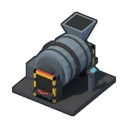 Mill, flour and water to dough on a
 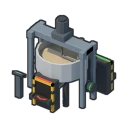 Mixer, dough to bread in an
 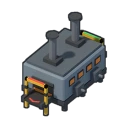 Oven. Level 1 towns want it.
 - Planks (
 Planks) from logs on a
 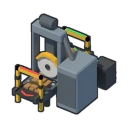 Saw: simple, and the start of
  Furniture,
  Tools and watchtowers. Logs on a Mill make pulp, and pulp on a
 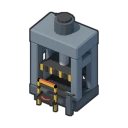 Press makes
  Paper.
 - Steel (
 Steel) from crushed iron ore and coal in a
  Furnace: the start of beams, tools, appliances and
  Cars.
Cars.
Factories without a floor#
A factory building with no floor laid out still works the old way: it makes generic goods for shops and sends them by its own delivery trucks to shops you own; when its stock is full it sells the surplus wholesale. Those goods are not catalogue goods and no storage keeps them. Once you lay out a floor, it makes only what its machines make.