The loop#
Every company grows the same way:
- Work the land. Buy a parcel of land and draw a field on it: a farm, a wood lot, a quarry. A field of a crop grows and is harvested every few days; a pasture, a quarry or a pump yields every hour.
- Build storage. A silo for grain, a yard for stone, a timber yard for logs. You can only sell from storage.
- Run a line. Buy a truck on a freight line from the field to the storage. Trucks and trains are the only way goods get into or out of storage.
- Sell. From the storage: raw goods to the computer, or anything on the players' market, or finished goods to towns.
- Grow. More land, more fields, bigger storage, trains, and then factories that turn raw goods into goods worth far more.
You start with $600,000. That is enough for a parcel of farmland, a storage and a truck or two, with room to spare.
Step 1: buy land#
Fly somewhere with farmland, woods or open country, then open Build → Land (B). The land around you is drawn on the ground in parcels, tinted by what it is: farmland, meadow, orchards, woods, open land. Your own land is outlined in your colour, other companies' in theirs.
- Parcels come from the real map: a field as mapped is a parcel; big woods, estates and land nobody has mapped are cut into parcels of up to 5 ha between the roads, railways, rivers and buildings. Built land is not for sale as land: buy its buildings instead.
- Hover a parcel for its card: what it is, its size, its price and what it can yield. Click to buy it.
- Land costs $4 a m² for farmland, meadow, orchards, woods and quarries and $2.50 for open land, grass and scrub, times 1× to 3× for where it is: the more built up around it, the dearer. A hectare of farmland in the country is $40,000.
- No land near you? The Land tab's Find land nearby lists the nearest parcels for sale of each kind.
- Land sells back at 90% of what you paid, once nothing of yours stands on it.
Step 2: draw a field#
On your land, Draw a field: pick what to grow (or to cut, dig or pump), then click the field's four corners. Any four corners will do, skewed or not, as long as the sides do not cross. The outline shows green while it is a field you can have, pink with the reason while it is not: off your land, over something already there, too small or too large. Confirm to make it.
- A field lies wholly on your land: on one parcel, or across parcels of yours that meet, never across a road or someone else's land.
- The land under it must yield what it grows: farm goods on farmland and meadow, fruit on farmland, orchards and vineyards, logs from woods, water beside a river or lake, and stone, coal, ore and oil from deposits under the land (a parcel has one or not; the card says).
- A hectare yields $3,600 worth of its good a day; a field yields its area's share. Its size is up to you: 500 m² to 10 ha, each side at least 8 m.
- Crops, fruit and logs grow: a field is ploughed, sown, ripens and is harvested, and the whole cycle's yield comes in at the harvest (a field of grain every 6 game days), the same a day on average. A new field starts with ploughing, so its first harvest is most of a cycle away. Livestock, water, stone, ore and oil come in every hour. See Farms.
- Running it costs 35% of that yield's worth a day, so each unit costs you about a third of what it is worth. Drawing a field costs nothing (a pasture is fenced as it is drawn); opening a mine costs $40,000 a hectare, an oil well $80,000.
- A field holds its harvest and 3 days of its yield more; a quarry, a mine or a pump 3 days of it. When it is full it stops (and still costs its running), so keep a truck taking it away.
| Good | Drawn as | Opening it, a hectare | On | A hectare, a day | Costs you | Computer buys | Computer sells |
|---|---|---|---|---|---|---|---|
 Logs Logs | Wood lot | nothing | woodland | 120 | $10.50 | $24 | $37.50 |
 Grain Grain | Field | nothing | farmland or meadow | 300 | $4.20 | $9.60 | $15 |
 Cotton Cotton | Field | nothing | farmland or meadow; within 40° of the equator | 180 | $7 | $16 | $25 |
 Livestock Livestock | Field | nothing | farmland or meadow | 60 | $21 | $48 | $75 |
 Fruit Fruit | Orchard | nothing | farmland, an orchard or a vineyard; within 60° of the equator | 225 | $5.60 | $12.80 | $20 |
 Stone Stone | Quarry | nothing | a mapped quarry, or land over a deposit (25% of parcels have one) | 257 | $4.90 | $11.20 | $17.50 |
 Sand Sand | Quarry | nothing | a mapped quarry, or land over a deposit (20% of parcels have one) | 450 | $2.80 | $6.40 | $10 |
 Clay Clay | Quarry | nothing | a mapped quarry, or land over a deposit (20% of parcels have one) | 360 | $3.50 | $8 | $12.50 |
 Iron ore Iron ore | Mine | $40,000 | land over a deposit: 6% of parcels have one | 164 | $7.70 | $17.60 | $27.50 |
 Copper ore Copper ore | Mine | $40,000 | land over a deposit: 4% of parcels have one | 120 | $10.50 | $24 | $37.50 |
 Coal Coal | Mine | $40,000 | land over a deposit: 8% of parcels have one | 200 | $6.30 | $14.40 | $22.50 |
 Crude oil Crude oil | Oil well | $80,000 | land over a deposit: 3% of parcels have one | 103 | $12.25 | $28 | $43.75 |
 Water Water | Water pump | nothing | land beside a river, stream, canal or lake | 1,800 | $0.70 | $1.60 | $2.50 |
 Corn Corn | Field | nothing | farmland or meadow; within 50° of the equator | 300 | $4.20 | $9.60 | $15 |
 Barley Barley | Field | nothing | farmland or meadow | 300 | $4.20 | $9.60 | $15 |
 Sunflower seeds Sunflower seeds | Field | nothing | farmland or meadow; within 55° of the equator | 200 | $6.30 | $14.40 | $22.50 |
 Canola seeds Canola seeds | Field | nothing | farmland or meadow | 200 | $6.30 | $14.40 | $22.50 |
Step 3: build storage#
Open Build → Storage and pick the kind that keeps your good: grain goes in 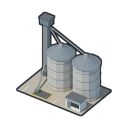 Grain silos, stone and ore in a
 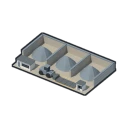 Stockpile yard, logs in a
 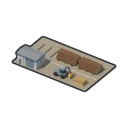 Timber yard, liquids in a
 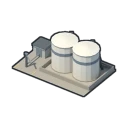 Tank farm. Every good has exactly one kind of storage; each good's page says which.
- A ghost follows the mouse. Q / E or the wheel turn it, a click builds it, right-click or Esc stops.
- It must stand on your land, clear of your fields and other storage. Off it, the ghost turns pink: Not your land: buy it in Land. Beside your field on the same parcel is the place for it.
- Storage costs a little every game hour to run.
See Storage for every type, its size, capacity and cost.
Step 4: a truck line#
Open Lines (L), choose + New line, Road, then where it loads (your field) and where it delivers (your storage). That buys the first truck: $45,000, $150 a day, 200 units a load.
- A truck waiting at the loading end takes the good there is most of that the far end has room for (at least a quarter load), loads, drives, unloads what fits, and comes back.
- It drives the real roads at real speeds through the traffic, so keep fields and storage close at first: on the same parcel is ideal. The furthest a truck line reaches is 30 km.
- A line's + buys it another truck; − sells one back for half.
- A storage's card also has New line here.
Step 5: sell#
Open Market (M), pick your good, and sell it from your storage.
- Raw goods sell to the computer at 0.8× their worth (and it sells them at 1.25×). Its price drifts down as the whole world sells to it and back up as the world buys: between 0.7 and 1.4 of the normal price.
- Anything can be offered on the players' market at a price you set.
- Finished goods sell to towns within 30 km of your storage.
See The market for the rules.
A worked example#
A hectare of grain yields about $3,600 of grain a day. Sold to the computer at 0.8×, that is more than twice what the field costs to run. Buy a few hectares of farmland, draw a field on most of it, put a Grain silos in the corner that is left, a truck between them, and sell from the silo when the price suits you.
What next#
- More fields of the same good, all feeding one storage, and farm buildings beside them: a farmhouse for more yield, a barn for more room, a machinery shed for cheaper running. See Farms.
- Trains once goods have to go further: a train carries 1,200 units between two rail yards up to 60 km apart. See Transport.
- Factories. A good made from others is worth what went into it plus the machine's time plus 15%. Bread is worth $25.63, steel $198, furniture $255, a car $1,916. See Factories and Production chains.
- Towns pay 1.15× a good's worth for what they want, and grow as you supply them, wanting more. See Towns.
- Property. Houses let to tenants, offices and shops earn a share of their price every day. Click any residential, commercial or industrial building to buy it.
Property, briefly#
Every real building is property. Its price is its floor area times a rate for its class: $800 a m² residential, $1,000 commercial, $450 industrial, and never under $25,000. Public buildings (schools, churches, stations) and outbuildings cannot be bought.
- Residential is let to tenants: 1% of its price a day.
- Commercial runs offices (1.2% a day) or a shop. A shop sells to the people living within 600 m, split with every other shop that reaches them.
- Industrial runs a factory. See Factories.
- Any business costs 0.15% of its price a day to keep up. Sold, a building fetches 90% of its price.