The one rule: sell from storage#
Everything is sold from storage, and everything bought is delivered into storage. Every kind counts: warehouses, silos, yards, tanks, cold stores, pens and rail yards. Nothing is sold straight from a field or a factory: what a field yields and what a factory makes is trucked or trained to storage first.
- Selling to the computer, offering on the players' market, and selling to a town all name one of your storages.
- Buying (from the computer, or on a buy order) names a storage of yours that keeps that good and has room for it.
What goods are worth#
Every good has a worth, the reference every price is measured against:
- Raw goods have a worth each: grain $12, logs $30, stone $14, crude oil $35…
- Made goods are worth their cheapest recipe: what goes in, plus the machine's time ($2 + $0.05 a kW, a second), plus 15%. Bread comes to $25.63, steel $198, furniture $255, a car $1,916.
Every good's page shows its worth; Goods lists them all.
The computer's raw market#
The computer trades raw goods only, any amount (up to 10,000 units at a time), at any time.
- It buys at 0.8× a good's worth and sells at 1.25×, times its drift.
- The drift falls as the world sells a good to it and rises as the world buys, between 0.7 and 1.4. The pressure fades by 3% an hour, measured against 20 days of a hectare's yield.
- Even at its lowest, buying from the computer costs over twice what producing a good yourself does. Work the land.
The players' market#
Everything else (and raw goods too, between players) trades on an order book, good by good.
- An order stands on one of your storages: an offer to sell from it, or a bid to buy into it.
- An offer's goods leave the storage's stock but keep their room there until they sell; withdrawn, they go straight back.
- A bid is paid for as it fills, delivered into its storage, and keeps room there for the rest. A bid you can no longer pay for is withdrawn.
- A new order trades at once against the best standing ones, at their price; whatever is left stands.
- The seller pays a 3% fee. You can have 50 orders open at a time.
- Every good keeps 7 game days of hourly prices and volumes; the Market panel charts them.
Towns#
Every town and city on Earth is a customer. A town buys finished goods from storage of yours within 30 km, at 1.15× their worth, 5% more for each level above the first, up to a day's wants of each good.
- Size: the square root of its population over 20,000, from 0.5 to 8. A city of 1.3 million is size 8; a town of 20,000 is size 1.
- Wants: 40 units a day of each good per unit of size, and 50% more for every level since the good first came in.
- Growing: what a town takes counts toward its next level: $60,000 times its size to reach level 2, doubling each level. Level 5 is the top.
- Rivals: a town buys from anyone; its day's wants go to whoever gets there first.
| Level | Wants (new at this level) | Pays |
|---|---|---|
| 1 |  Bread Bread Cornmeal Cornmeal Bottled juice Bottled juice Canned fruit Canned fruit Packaged meat Packaged meat Cooking oil Cooking oil | 1.15× worth |
| 2 |  Clothing Clothing Shoes Shoes Furniture Furniture Paper Paper Bottled beer Bottled beer Glassware Glassware Fuel Fuel | 1.208× worth |
| 3 | 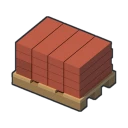 Bricks Bricks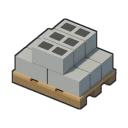 Concrete Concrete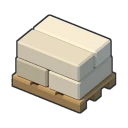 Stone blocks Stone blocks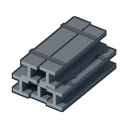 Steel beams Steel beams Tools Tools Plastic goods Plastic goods Toys Toys | 1.265× worth |
| 4 |  Appliances Appliances Electronics Electronics Ethanol Ethanol | 1.323× worth |
| 5 |  Cars Cars | 1.38× worth |
See Towns for sizes and thresholds, and each good's page for the towns that want it.
Moving goods about#
- Goods move between your own fields and factory buildings at once, for $0.50 a unit.
- Into and out of storage, only trucks and trains carry them (see Transport), and selling takes them out.
- An old save's depot takes nothing in now; what it held can be sent out of it to any of your places with room, at the same fee, and still builds defences.